from the 19 alleles listed on the document below in the table "Profile":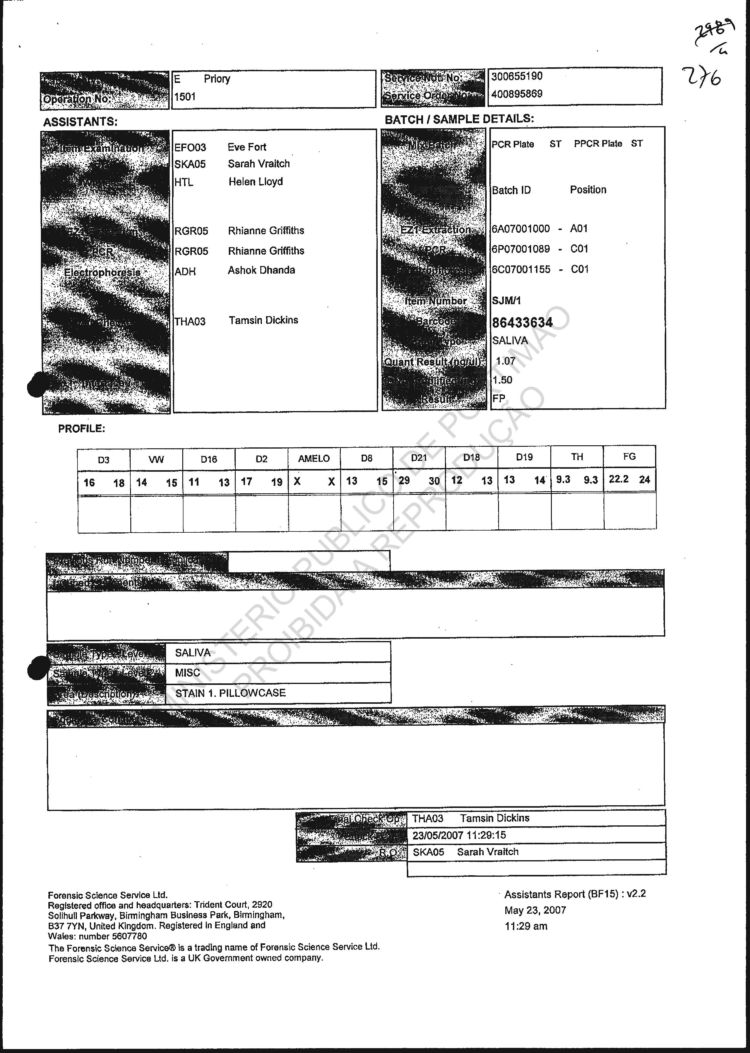
at the 10 loci listed it should be possible to reinstate the loci headings on this page where the electropherograms are displayed in spite of the fact that the loci names have been crossed out in the graphs displayed on the page below.
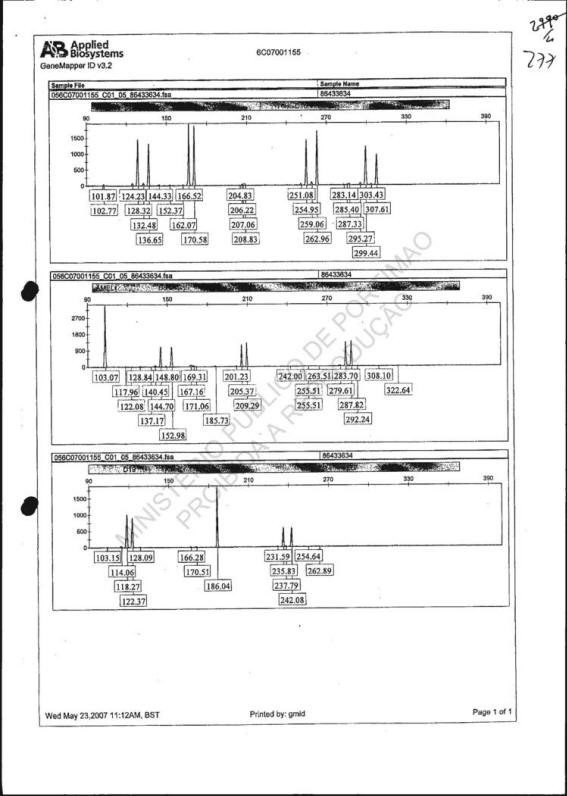
Until we can get the evidence sample results we are stuck being unable to assess whether the Forensic Science Service Ltd was correct in saying the sample was not proof that Madeleine's cadaver was in the car or not.
If the sample was mixed sample just sourced from Gerry and Kate there would be a total of 37 different alleles to show up, and I think their profiles were already known, so if there were additional alleles appearing that suggests a third person in the mix.
"A complex LCN DNA result which appeared to have originated from at least three people was obtained from cellular material recovered from the luggage compartment section 286C 2007 CRL10 (2) area 2. Within the DNA profile of Madeline McCann there are 20 DNA components represented by 19 peaks on a chart. At one of the areas of DNA we routinely examine Madeleine has inherited the same DNA component from both parents; this appears therefore as 1 peak rather than 2, hence 19 rather than 20. Of these 19 components 15 are present within the result from this item; there are 37 components in total. There are 37 components because there are at least 3 contributors; but there could be up to five contributors. In my opinion therefore this result is too complex for meaningful interpretation/inclusion."
http://www.mccannpjfiles.co.uk/PJ/MADELEINES_DNA.htm
4 of the 19 alleles belonging to Madeleine were missing so the mixed sample is not likely to be both the mother and the father for then all the missing alleles would have been replaced. It could be the mother plus someone else (so the sex allele stays the same). I think the result could also occur if one of Kate's eggs were fertilized with Gerry's sperm producing a closely related individual of the female sex.
The lecture by Dan Krane covered related individuals (quite difficult to understand it all though).
https://www.youtube.com/watch?v=daRBTopFA1A&list=UUjpWy3YdG24iySWTBS4jU2Q&index=5 for mixed samples.
Thanks for the link to Dan Krane's video. I'm only up to around 22 mins, but will watch the rest later. So far, I find it to be well explained.
The key point of interest to me is how far the probability changes when just 1 result out of 26 potentially different alleles (the FBI database examines 13 markers) is discounted as irrelevant background noise when, in fact, it may not be. I wonder how many people are on Death Row as a result? I also wonder how many in the UK may be serving lengthy prison sentences when they only examine 10...
The UK forensic system examines (or did) 10 markers (i.e. it searches for 2 alleles at each of the 10 loci). There was talk of moving to a higher number and I haven't followed whether it eventually did or not, nor why exactly they may not have done. The more, the better, I would have thought.
The INML in Portugal did their very best in M's case in the samples submitted to them (mainly related to the flat shortly after her disappearance), using two different kits to maximise the number of loci to examine. (The two kits largely overlap in terms of loci, but there were a few extra ones.)
That said, from what I've listened to so far, the context seems to be within the context of a defendant being convicted who may not have been the real perpetrator of a crime.
For the moment, the 15/37 boot issue seems quite different to me: DESPITE the fact that the UK system only examines 10 loci, there was evidence of "at least 3 contributors; but there could be up to five contributors":
"A
complex LCN DNA result which appeared to have originated from at least three people was obtained from cellular material recovered from the luggage compartment section 286C 2007 CRL10 (2) area 2. Within the DNA profile of Madeline McCann there are 20 DNA components represented by 19 peaks on a chart. At one of the areas of DNA we routinely examine Madeleine has inherited the same DNA component from both parents; this appears therefore as 1 peak rather than 2, hence 19 rather than 20. Of these 19 components 15 are present within the result from this item; there are 37 components in total. There are 37 components because there are at least 3 contributors; but there could be up to five contributors. In my opinion therefore this result is too complex for meaningful interpretation/inclusion."http://www.mccannpjfiles.co.uk/PJ/MADELEINES_DNA.htm

